How Job File Documentation Affects What Your Restoration Company Is Worth
Brighthammer Field TeamBusiness
Key Takeaways
- Small owner-operated shops are usually priced on SDE multiples; weak job files show up as aged A/R, carrier cuts, and owner dependency discounts.
- A written documentation standard and a weekly audit beat ad hoc fixes—and twelve months of completeness data is evidence buyers can verify.
- Automate reminders and completeness checks only after hand audits show what “complete” means for each loss type.
A small restoration company usually sells for a multiple of what the owner takes home, and that multiple tends to be lower than the owner expects. A buyer is paying for earnings they believe will keep coming after the owner leaves. Most of due diligence is the buyer looking for reasons to believe less.
Many of those reasons are in the job files. Receivables sit past 90 days because a carrier wants more support. Line items get cut because nobody photographed the equipment in place. The owner is the only person who knows how to write up a Category 3 loss so it actually gets paid. None of this shows up as a "documentation problem" on the P&L, but that's usually where it starts.
You'll hear a lot right now about "tech-enabled" restoration companies earning software-style valuations. For a shop with fewer than 10 employees, the realistic version is less exciting and more useful: job files that are complete and consistent, and that don't need the owner to get them that way. This guide covers how small restoration companies are usually valued, what buyers check, and how to set up a documentation standard and a weekly audit that will hold up when someone looks.
How Small Restoration Companies Are Usually Valued
Owner-operated companies are usually priced on seller's discretionary earnings (SDE). That's profit before the owner's salary and perks, interest, taxes, depreciation, and amortization. Once a company has managers who run it day to day, buyers switch to EBITDA, which treats a market-rate manager salary as a real cost.
One M&A advisory firm's 2026 guide publishes the ranges below. Other advisors publish different numbers, and any single deal can land well outside them.
| Company profile | Published typical multiple |
|---|---|
| Owner-operated, under $500K SDE | About 2.8x |
| Owner-operated, $500K to $1M SDE | About 3.0x |
| Owner-operated, $1M to $2M SDE | 2.3x to 3.6x |
| Under $2M EBITDA, no clear differentiation | About 3.2x to 4.3x |
| $2M to $5M EBITDA | 4.0x to 7.0x |
| $5M to $10M EBITDA | 5.0x to 8.5x |
The double-digit multiples you hear about at conferences usually go to large regional platforms or companies with preferred carrier programs. A six-person water mitigation shop isn't in that group. For most small owners, the practical goal isn't to jump into a new valuation category. It's to avoid discounts and to grow the earnings the multiple is applied to. Both of those come back to the job file.
What Buyers Check, and Where the Job File Shows Up
| Diligence area | What the buyer wants to know | How job files affect it |
|---|---|---|
| Aged receivables and supplements | How much of your A/R will actually be collected | Files missing readings, photos, or a signed work authorization are often the ones still open after 90 days. Buyers may discount aged A/R heavily when they set working capital. |
| Carrier and TPA relationships | Whether the work is repeatable and meets program KPIs | Cycle time and file-quality scores depend on how fast a complete file gets to the adjuster. |
| Owner dependency | Whether revenue holds up without you | If only the owner documents to standard, the buyer is buying a role they'll have to hire for. |
| Field systems and data quality | Whether job history can be verified | Buyers may pull sample job files. At least one advisory guide lists photo documentation completeness as a review item. |
| Disputes and litigation | Exposure from carrier or customer disputes | The file is your evidence: signed authorizations, timestamped readings, and a clear line between what the technician observed and what the occupant reported. |
| Revenue quality | Whether margins are real or came from one storm season | Consistent files let you show margin per job by loss type instead of one annual number. |
Owner Dependency Is Mostly a Documentation Problem
In a lot of small shops, the owner is the documentation standard. They know which adjuster wants a moisture map on every visit, which photos prove containment went up, and how to justify the fourth air mover in a Class 3 room. Techs capture what they're told to capture, and the owner fills the gaps at the kitchen table at night.
That works until the owner gets sick, takes a week off, or tries to sell. A buyer sees a company whose collections depend on one person's memory and adjusts the offer to match.
The fix is a written standard that a second-year tech can follow without calling anyone. For water mitigation, a file should have all of this before it's invoiced:
Mold, fire, and contents files need their own lists. Start with the loss type that brings in the most revenue and add the others later.
- Cause of loss, noted as either observed by the technician or reported by the occupant
- Water category and class, with the observation that supports each one
- An initial moisture map with readings by room and by material
- A dry standard for each affected material, taken from unaffected material of the same type
- The equipment placed, plus the calculation behind the count, so each unit can be justified line by line
- Daily readings and an equipment log for every visit, including atmospheric readings inside and outside the structure
- Photos for every room: before work, during with equipment running, and after
- A signed work authorization, plus a signature on any scope change before the extra work is done
- Final readings showing every material reached its dry standard
- A signed certificate of completion
Run a Weekly Job File Audit
You don't need custom software to audit job files. Thirty minutes every Monday does the job, and doing it by hand first shows you which parts are worth automating later.
- Pull every job that was invoiced or marked dry in the past week.
- Check each file against your written standard. Record exactly which items are missing. "Looks fine" doesn't count.
- Send each gap back to the tech who ran the job, that same week. A day-3 reading that was never taken can't be recreated, but a missing photo label or an unsigned form usually can be fixed while the job is still fresh.
- Log two numbers: the percentage of files that were complete when invoiced, and the dollar amount of carrier reductions along with the reason the adjuster gave for each.
- Once a month, read through the reduction reasons. If the same item keeps getting cut (a dehumidifier on day 4, antimicrobial application, the equipment count in one room), add a line for it to the standard.
The log is useful beyond this week's cleanup. Twelve months of completeness and reduction data is evidence a buyer or lender can check, and it's hard to fake after the fact.
Hypothetical: What Documentation-Related Reductions Cost at Sale
Take a company that runs 120 water mitigation jobs a year with an average invoice of $4,500. That's $540,000 billed. Now say 6% of the billed amount gets cut because documentation was missing or weak. That's $32,400 a year. The labor and equipment were already paid for, so nearly all of that comes straight out of profit.
At a 3x SDE multiple, that's about $97,000 of sale value, and that's before you count slower collections on the files that get disputed. Recover half of those reductions and you add $16,200 a year to SDE, or roughly $48,600 at the same multiple.
Hypothetical example: This is a hypothetical example to show how carrier reductions flow into valuation. The job count, invoice amount, reduction rate, and multiple are illustrative only. They aren't benchmarks for any real company.
Where Automation Fits for a Small Shop
AI phone answering, automated follow-ups, file-completeness checks, and estimate comparisons all come up when people talk about making restoration companies more efficient. Some of them are worth it at small scale. All of them depend on the data you already capture. If your files are inconsistent, an automated audit will flag almost everything, and an AI summary will just write up incomplete information more neatly.
| Task | Worth it under 10 employees? | What has to be in place first |
|---|---|---|
| After-hours call answering | Often yes, since a missed 2 a.m. water call is usually a lost job | Clear intake questions and an on-call rotation the service can route to |
| Daily reading reminders and follow-ups | Yes | Every active job has an assigned tech and a scheduled visit |
| File-completeness checks | Yes, after a few months of auditing by hand | A written standard for each loss type |
| Comparing your estimate to the carrier's | Useful, but a person still needs to review it | Line items written consistently, each backed by photos and readings |
| Custom AI workflows in general automation tools | Usually not a first step | Someone with time to build and maintain them, and clean data to feed them |
For most small companies, the order is: standardize what techs capture, audit it by hand, then automate the parts you've proven. Buyers and adjusters look at the finished file, not at the tools that produced it.
Document to One Standard Across the Crew
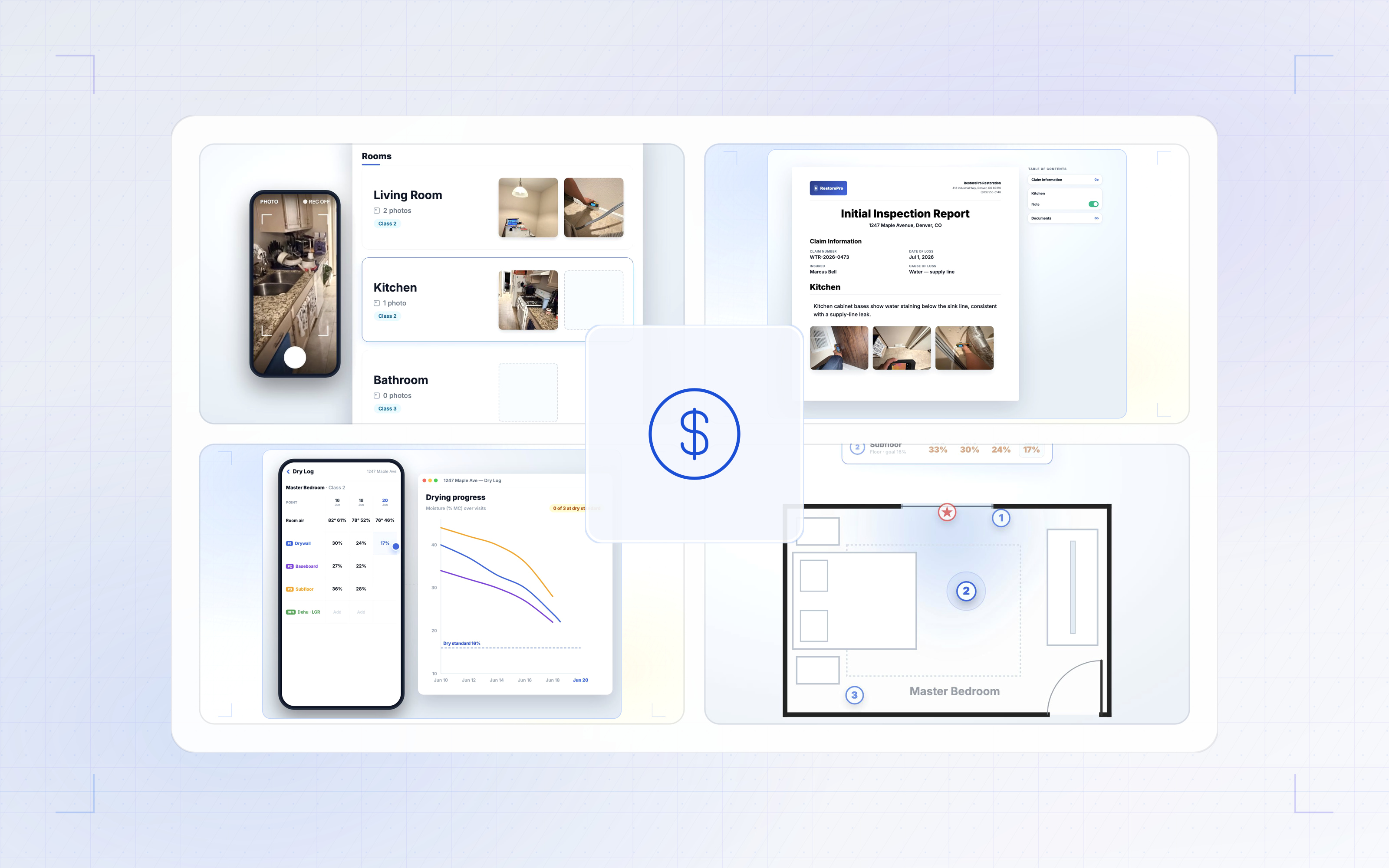
Brighthammer's water mitigation workflow puts moisture readings, equipment logs, drying logs, room-by-room photos, e-signatures, and carrier-ready reports in one job file. Every tech on every plan can document to the same standard, with flat-rate pricing and unlimited users.
FAQs
Most owner-operated restoration companies are valued as a multiple of seller's discretionary earnings. Published ranges for companies under $2M SDE fall roughly between 2.3x and 3.6x. Where a company lands depends on carrier concentration, aged receivables, how much the business relies on the owner, and how consistent its earnings are from year to year.
They can, and many do. Buyers often pull a sample of job files to check photo completeness, reading logs, and signed authorizations, and they compare that against aged receivables and carrier disputes. Files that look different from one tech to the next suggest the earnings depend on specific people.
SDE adds the owner's salary and personal perks back into profit, so it's used for businesses where the owner runs daily operations. EBITDA treats a market-rate manager salary as a cost. It's used once a company has a management layer that can run without the owner.
Write down the documentation standard the owner currently carries in their head, train techs to it, and audit against it every week. When files reach the adjuster complete without the owner touching them, that dependency starts to show up less in diligence.
At minimum: cause of loss, water category and class with supporting observations, an initial moisture map, a dry standard for each affected material, equipment placement with the calculation behind it, daily readings and equipment logs, room-by-room photos, a signed work authorization, final readings, and a signed certificate of completion.
Software alone doesn't change the multiple. What can help is the result: complete, consistent job files, fewer carrier reductions, faster collections, and a documentation process that doesn't depend on the owner. Software that techs actually use in the field makes those results easier to get and easier to prove.
Weekly works for most small shops. Gaps get caught while techs still remember the job, and the habit builds a record of file completeness and carrier reductions over time.